|
History of Rhodes
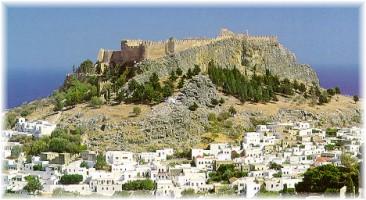
The human presence on Rhodes can be traced with certainty back to the Stone Age. The most important event in the ancient history of Rhodes was the merging of its three city-states [Kamiros, Lindos, Ialyssos] which occurred between 411 and 408-407 BC. |
|||||
|
|||||
|
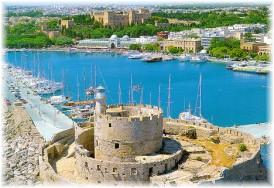
The new city which they decided to build, named Rhodes, was laid out on the northern extremity of the island designed by Hippodamus of Miletus the greatest town planner of antiquity. The ships of Rhodes roved the Mediterranean, and the seafaring and commercial activities of the citizens filled the town with wealth. |
|||||
|
|
|
||||
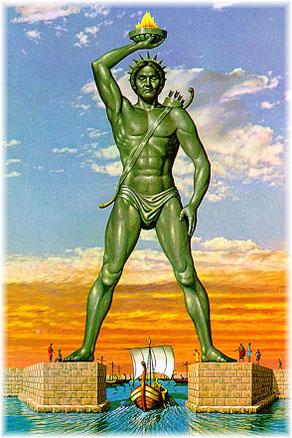
| Apart from being a powerful and independent state, Rhodes also developed at this time into an important center of learning and education. Schools of rhetoric and philosophy sprang up. The great sculptors Deinocrates and Hares were themselves sons of the island, and it was the latter of the two who created the famous Colossus of Rhodes. [This was a splendid bronze statue of Helios,31 m. high, which they erected at the entrance to their busy harbor, and which constituted one of the seven wonders of the ancient world. The statue, took a full twelve years to complete, has unfortunately not survived to our day. It was destroyed in the great earthquake of 227/6 BC.]. In 305 BC, Rhodes spent a year under siege from Demetrius the Besieger and eventually beat him off. This victory consolidated the island’s independence and strengthened its democratic institutions. It reached the height of its economic and political power in the 3rd century BC and the first half of the 2nd century. Under the Roman Empire Rhodes enjoyed a measure of nominal independence. | |||||
|
|
|||||
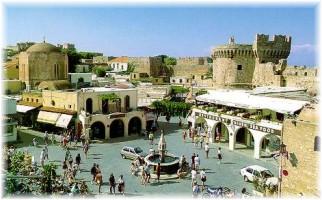
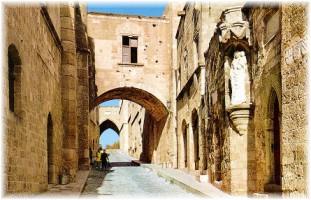
| In 395AD, after the division of the Roman Empire, Rhodes was attached to the Byzantine Empire. The economy of Rhodes became active once more in the post-Byzantine period. As the western Europeans waged the wars of the Crusades in the East, ships from all across the continent moored in Rhodes harbor. And together with the economy, all other areas of life in Rhodes flourished. In 1309 the knights of the St John of Jerusalem settled in the Dodecanese. Given the multinational composition of the chivalric order, Rhodes inevitably came into economic, political and cultural contact with all of Western Europe. The harbor became one of the most important portals through which goods and ideas passed east from Western Europe. Particularly, after the mid-15th century the Greek population seems to have prospered. A numerous scholarly class of Greeks and Westerners cultivated learning and studied the Classical writers in Greek and Latin. This mixed population of Greeks, Westerns and Jews lived together in a walled city surrounded by orchards of fruit trees. An interior wall running east-west divided the city into two unequal parts. | |||||
|
|
||||
|
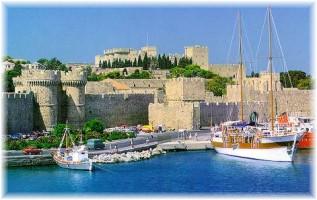
The more northerly, and smaller, of these parts was called the Collachium, it was the administrative center and contained the Palace of the Grand Master, occupying the ancient acropolis, the Hospital, the inns of the ‘‘tongues’’, the church of St John, and many other buildings. The larger southern quarter was the town itself, known as the Burgus or Burgum. Here lived a blend of races, with the Greeks in the majority. In 1522, after a bloody Turkish siege led by Suleiman I, the knights were forced to evacuate the island. Turkish sovereignty over Rhodes lasted until 1912,when it was occupied without resistance from the Turkish troops, by the Italian army. After the II World War ended, the island was liberated from the defeated Italians by the Greek and other Allied Army Forces and united with Greece in 1947.Nowadays, Rhodes attracts more tourists than any other Greek island, and it is once more a crossroads for the peoples of the world, who come to enjoy its natural beauty and the historical memories which permeate its atmosphere and can almost be said to emanate from the soil.
|
|||||
|
|
|
|
|||